EMT Practice Test

1. Question Content...


Question List

Question1: A PV system's annual energy production is 15,000 kWh. After maintenance, production increases by 5%.
What is the new annual output?

Question2: According to the NEC, if the PV system disconnect and the building service disconnect are at different locations, there MUST be a/an:

Question3: Inspection of a new PV installation shows that the dwelling uses a galvanized water pipe for its grounding electrode and that the PV system now shares the connection. Which of the following is an acceptable supplemental electrode method to ensure the integrity of having a grounding electrode?

Question4: A PV array is installed on a sloped roof with a 6:12 pitch. What is the minimum fastener pullout strength required if the uplift force is 200 lbs per attachment point?

Question5: A bifacial PV module has a rated power of 350W on the front side and a bifaciality factor of 70%. If the rear side receives 200 W/m² of irradiance, what is the total power output under STC front-side conditions (1000 W
/m²)?

Question6: A system's annual output decreases by 10% due to shading. The original output was 20,000 kWh. What is the new output?

Question7: Aerial lifts used to hoist equipment and PV modules to roof levels may be fieldmodifiedfor uses other than those intended by the manufacturer with which approval or certification?

Question8: A 20 kW system has a measured output of 18 kW at STC. What is the total system loss?

Question9: A 20 kW array has a measured output of 16 kW at 800 W/m² irradiance. What is the performance loss due to irradiance?

Question10: A PV system installation utilizes micro inverters connected to each module of the array. Each micro inverter has a nominal rated output of 250WV. Single phase. The microinverters are listed so that multiple inverters may be connected in parallel to a single feeder circuit, and each inverter has ancable and connector rated for
30A. What is the MAXIMUM number of inverters that may be wired together on a single 30A feeder circuit?

Question11: A PV system is designed for a location with a peak sun hours (PSH) value of 4.5. The daily load is 18 kWh, and the system efficiency is 80%. What is the minimum array size required in kW?

Question12: An installer is using ½ in lag boits to secure roof-monitoring hardware to rafters through a roof deck. Which of the following should the installer predrill?

Question13: Which is a requirement for designated battery rooms?
Question14: A system's inverter efficiency drops from 97% to 94% due to aging. What is the percentage increase in energy loss?

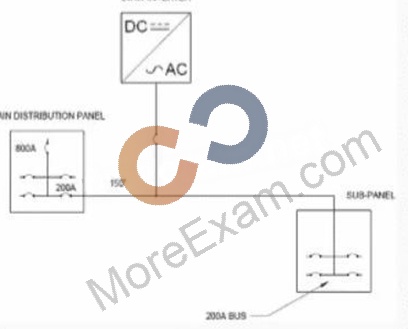
Question15: The point-of-utility connection of a residential utility-interactive PV system is in the main distribution panel.
If the busbars of the main distribution panel are rated at 200A, and if the distribution panel has a 200A main breaker, the rated output current of the inverter cannot exceed.

Question16: A ground-mount array uses driven piles with a lateral load capacity of 500 lbs. The wind load calculation yields a lateral force of 600 lbs per pile. What must be done?

Question17: A rooftop PV array uses a ballasted racking system with a total weight of 4 psf. The roof's maximum allowable load is 20 psf, including a snow load of 15 psf. Is this installation permissible?

Question18: A bank of batteries with capability of supplying 250A and a maximum voltage of 325V is housed in a concrete structure in a very humid location. There is service access alsie between rows of batteries. What is the REQUIRED safety distance between the rows of batteries.

Question19: A PV connection is being made at the center of a 300 ft. long 200 feeder. See the attack diagram. The feeder originates in the upper third of the 800A main service panel (800A main breaker) with a 200A breaker and terminates in a 200A main-lug-only subpanel. The rated output of the PV system inverter is 100A.

Which are the NIMUMUM actions required to achieve an NEC-compliant installation?

Question20: A metal condult containing an array circuit with Vmo of 400Vdc is connected to a metal enclosure at the location where the concentric knockouts have been punched by the manufacturer. Which method of attachment should be used?

Question21: A grid-tied PV system uses a transformerless inverter with a maximum DC input of 1000V. The array consists of 20 modules, each with a Voc of 45V. What is the NEC 690.7 correction factor for a low temperature of -15° C if the temperature coefficient is -0.30%/°C?

Question22: A PV system includes a 15 kW array with a maximum power point voltage of 450V and current of 33.33A.
The inverter efficiency is 97%, and the AC output voltage is 240V. What is the AC output current under STC?

Question23: A PV system has a 1000V DC array feeding a transformerless inverter. What is the minimum insulation rating for the DC conductors per NEC 690.35?

Question24: A PV system combiner box contains six source circuits, each with an Isc of 8A. The output conductor is 6 AWG THWN-2 copper rated at 90°C. What is the maximum allowable OCPD rating per NEC?

Question25: A commercial 600v carport-mounted PV system is installed with rigid running under the parking lot to an inverter pad located at the edge of the parking lot. At what depth below the parkinglot base MUST condult be buried?

Question26: A module's Isc is 9A at STC. At 600 W/m² irradiance, what is the expected Isc?

Question27: A 5 kW system has a PR of 0.80 and operates at 4.5 PSH. What is the monthly energy output?

Question28: A PV array's tilt is 15° at a latitude of 35°N. What is the annual energy loss compared to optimal tilt?

Question29: A grid-tied PV system uses a transformerless inverter with a maximum DC input of 1000V. The array consists of 20 modules, each with a Voc of 45V. What is the NEC 690.7 correction factor for a low temperature of -15° C if the temperature coefficient is -0.30%/°C?

Question30: A PV array is installed at a site with an annual average temperature of 25°C and a maximum recorded temperature of 45°C. The module Voc is 50V at STC, with a temperature coefficient of -0.32%/°C. What is the maximum string voltage at the coldest expected temperature of -10°C?

Question31: A PV array's output drops by 8% due to shading from 10 AM to 2 PM. If unshaded output is 12 kW, what is the shaded output?

Question32: A PV array's tilt is 30° at a latitude of 40°N. What is the winter energy loss compared to optimal tilt?

Question33: An 8 AWG bare copper equipment ground conductor (EGC) is wire tied to the module mounting structure of a commercial rooftop solararray. After a few years of operation, some spots on the EGC begin to turn a green color and appear to be corroding more significantly that other places. What would the MOST likely cause of the problem?

Question34: A system's performance ratio (PR) is calculated as 0.85. If the array capacity is 10 kW and PSH is 5, what is the daily AC output?

Question35: A maintenance inspection reveals cracked module glass. What is the immediate action?

Question36: A AWG THWN-2 PV output conductors from two PV arrays are run in the same 3 in, conduit to their respective functionally grounded inverters in the building. The three PV source circuits are each protected by a 15A fuse in the combiner box at the array. The conduit, which is strapped directly to the roof, is exposed to design temperatures of 140' F (60' C) during its 30 ft.
Exposed run. What is the MAXIMUM current carrying capability value of the PV output conductors?

Question37: A PV output circuit requires a disconnecting means per NEC 690.13. Where must it be located?

Question38: During a PV system inspection, an installer notices that the rapid shutdown system fails to de-energize the array within 30 seconds of initiation. What is the most likely cause based on NEC 690.12 requirements?

Question39: A site survey indicates a residential roof with a 4:12 pitch facing 20° east of south. The local latitude is 35°N, and the optimal tilt for maximum annual production is equal to latitude. What adjustment should be made to compensate for the roof's orientation and tilt to achieve near-optimal output?

Question40: A PV array is installed near a pool. What is the minimum distance required from the water's edge per NEC
690.31?

Question41: During commissioning, a PV system's measured Voc is 10% lower than expected. What is the most likely cause?

Question42: On a PV system larger than 100kw, which PV array design will provide the HIGHEST degree of performance monitoring.
Granularity, and ease of troubleshooting performance issues?

Question43: An 8KWsc roof-mounted array is placed on a school building. The inverter is located within 1 ft, of the array boundary and has an integrated ac-and dc-disconnecting switch. The system is to be connected to a 400A load center, protected by a 400A main breaker. Which of the following MUST be included to meet NEC requirements?

Question44: A 12 kW array has a measured output of 10 kW at STC due to mismatch losses. What is the mismatch loss percentage?

Question45: A PV array is located 8 feet from a property line. What is the minimum height above ground for exposed DC conductors per NEC 690.31?

Question46: How should stratification be eliminated in a set of large, stationary, stationary flooded lead-acid batteries?

Question47: A grid-tied PV system uses a transformerless inverter with a maximum DC input of 1000V. The array consists of 20 modules, each with a Voc of 45V. What is the NEC 690.7 correction factor for a low temperature of -15° C if the temperature coefficient is -0.30%/°C?

Question48: Which of the following is an NEC requirement regarding access for large-scale PV electric power production facilities?

Question49: A PV system produces 12,000 kWh annually at a site with 1500 kWh/m²/year insolation. The array area is 50 m². What is the system efficiency?

Question50: A rooftop PV system is being installed on a residential building with a 30-degree tilt angle. The modules are oriented directly south in a location where the solar noon altitude on December 21st is 30 degrees. What is the minimum distance required between two rows of modules to avoid shading between 9 AM and 3 PM solar time, assuming the module height is 3 feet?

Question51: The AHJ for enforcement of the NEC has which responsibility?
Question52: Which insulation color is allowed for a current-carrying roottop dc conductor on a functionally grounded 6kw PV system?

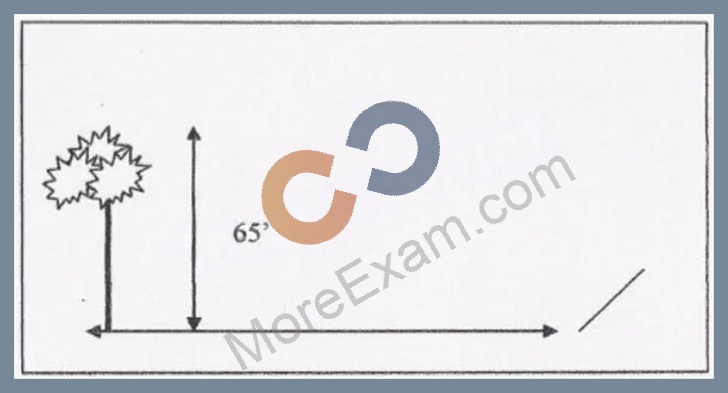
Question53: A PV system is located at 41 N latitude. The sun angle is 23 on December 21 at solar noon. Assuming that the
65 ft tree is directly south of the PV array and will grow 20 ft. over the life of the PV system, what is the MNIMUM distance the tree to the button of the prevent shading?

Question54: A homeowner is concerned that a 6kWdc PV system might be experiencing a performance issue. The homeowner has noticed what appears to be declining production. The installer analyzes the following data acquisition system (DAS) results for each year since the installation:

Given the data, which is the MOST likely conclusion to draw?

Question55: Which of the following MUST be referenced for determining a site's design wind speed?

Question56: A PV module shows burn marks near the junction box. What is the most likely cause?

Question57: Per NEC 690.11, what is the maximum allowable DC voltage for a PV system requiring arc-fault circuit protection?

Question58: A module's power is 340W at STC. At 700 W/m² and 40°C with a coefficient of -0.38%/°C, what is the output?

Question59: A 10 kW PV array uses 300W modules with a Voc of 40V and an Isc of 9A. The inverter has a maximum DC input of 600V and 25A. What is the maximum number of modules that can be connected in a single string?

Question60: Which of the following tests measures axial uplift whenperforming load testing of driven-pile foundation members

Question61: A customer has a 200A service with a 200A rated panel and 200A main breaker located on the street side of the house. There is a 100A breaker located at the opposite end of busbar feeding a 125A subpanel in the backyard. The customer would like to place the inverter the backyard and use the 125 subpanel. Which MAXIMUM inverter(s) output circuit current could be installed?

Question62: A grounding electrode is required at the location of all ground-mounted and pole-mounted PV arrays. Which typeof grounding electrode is NOT permitted for arrays. Which type of the grounding electrode is NOT permitted for array grounding?

Question63: Which of the following voltages should be included on the dc disconnected label to indicate MAXIMUM system voltage?

Question64: The NEC requires that PV systems installed on dwellings incorporate which of the following components?

Question65: A rooftop PV system is proposed for a commercial building with a membrane roof. The structural engineer specifies a maximum allowable dead load of 5 psf. The PV modules weigh 3 psf, and the racking adds 1.5 psf.
What additional load can be added without exceeding the limit?

Question66: A technician has been called to a scale due to a low-performing array. The technician will perform tests in the
24-source circuit combiner box. After putting on the correct PPE and turning off and performing lock.tagout of the inverted and combiner disconnect. Which is the next step to safely begin electrical testing in the combiner box?

Question67: When installing an ungrounded PV system with an open-circuit voltage of 450Vdc and a maximum voltage of
3000Vdc which procedures should be followed to establish an electrically safe condition?

Question68: A ground resistance measurement on a newly installed grounding electrode indicates a resistance of 130#. The earth connection may be improved by connecting the existing electrode to a:

Question69: A 10 kW array produces 14,000 kWh annually. What is the specific yield in kWh/kW?

Question70: According to the NEC, where on a residential PV system MUST the labeling describing the type of rapid shutdown be located?

Question71: A PV system is installed on a dwelling with a single-phase 240V service. The inverter output is 7.2 kW. What is the minimum service conductor size per NEC 705.12 if the existing load is 50A?

Question72: A 15 kW system has a total derate factor of 0.90. After 5 years, output drops by 2% annually due to degradation. What is the AC output in year 5?

Question73: A system's inverter output is 9 kW at 900 W/m² irradiance. What is the expected output at 1000 W/m²?

Question74: An installer is working on a 1000V DC PV array. What is the minimum PPE required per NFPA 70E for arc flash protection?

Question75: With all other environmental parameters being the same, which would be the expected reduction in KM performance of a PV system after an irradiance drop from 810w/m2 to 740w/m2?

Question76: A PV system is designed with a 48V battery bank and a 5 kW inverter. The load requires 20 kWh/day, and the system must have 2 days of autonomy with a maximum depth of discharge (DoD) of 50%. What is the minimum battery capacity required in Ah?